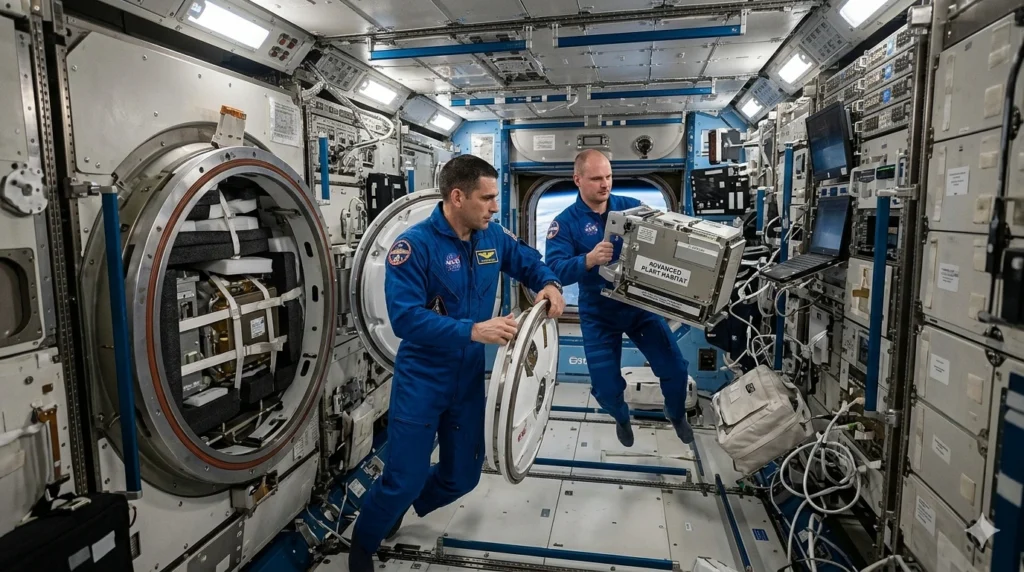

Expedition 74 Opens Cygnus XL on Tuesday, NASA flight engineers Chris Williams and Jack Hathaway were the first crew members to step into Cygnus XL. Before launch, the engineers tested the spacecraft again and again, checking pressure levels and leaks carefully inside. So the hatches opened, and the mission’s most important operation officially got underway.
On April 11 at 7:41 a.m., Cygnus XL lifted off from Cape Canaveral Space Force Station in Florida, riding a SpaceX Falcon 9 rocket. At 1:20 p.m. EDT, NASA astronaut Chris Williams, helped by Jack Hathaway, used the Canadarm2 robotic arm to capture the spacecraft. Later, mission controllers guided Canadarm2 from far away to attach the Cygnus XL to Unity’s Earth-facing port.
Northrop Grumman loaded the spacecraft with more than 11,000 pounds of lab equipment, experiments, and supplies for the crew. The ship also brought more than 2,300 pounds of brand-new research equipment and science experiments. The crew wasted no time. They started unloading first thing the next morning.
Soon after they entered, NASA’s Jessica Meir and ESA’s Sophie Adenot, both flight engineers, joined Williams and Hathaway. They moved their time-sensitive research samples from Cygnus’ portable freezers together. They put these samples into the station’s MELFI science freezers and MERLIN incubators to keep them safe.
As soon as the hatch opened, Roscosmos flight engineer Andrey Fedyaev began his shift by grabbing air samples inside the Cygnus XL. It kept the station’s inside environment clean and uncontaminated. Then Fedyaev turned his attention to keeping the Roscosmos module’s space systems running, including its ventilation.
The mission brings groundbreaking research power and strong science priorities. The team will soon study blood stem cells to help treat cancers and other blood problems. They’ll also learn how to keep astronauts’ guts healthy and watch proteins floating in water to help improve medicine production. They will also add a quantum physics module to boost what the Cold Atom Lab can do.
NASA astronaut Jessica Meir marked the achievement by praising Williams and Hathaway for their first successful capture of a cargo craft with Canadarm2. Yes, it was a proud moment for both astronauts, and it also hit a major mission milestone.
Besides running science tests, Cygnus XL brought ESA’s new workout setup, upgraded eye-imaging gear, and oxygen and nitrogen tanks to refill spacesuits. The shipment handled the crew’s urgent needs and also supported the long-term research plans at the same time.
On the Russian side, cosmonauts Sergey Kud-Sverchkov and Sergei Mikaev spent the day stuffing the Progress 93 resupply ship with trash and outdated gear. After seven months moored at the Zvezda service module’s back port, Progress 93 is almost ready to leave. The two set up their docking gear before they undocked next.
Cygnus stays at the International Space Station through October. Then it will head back into Earth’s atmosphere and burn up safely, breaking down and getting rid of several thousand pounds of debris.
Expedition 74 keeps stretching what we know through space science. Now that the full cargo manifest is on board, the seven-person international crew is prepared to push human understanding forward, experiment by experiment.
Sources: NASA Space Station Blog | NASA Expedition 74 Mission Page | Friends of NASA
Recent News:
China Warns Trump Iran Port Blockade Is “Dangerous”