
US Navy now faces its most complex mission in the Iran conflict. On Sunday, President Donald Trump ordered a complete naval blockade of Iran’s ports. He also ordered the Navy to clear Iranian mines from the Strait of Hormuz. Together, these tasks call for huge naval power, close allied teamwork, and smart tactics.
The Blockade Order
On Truth Social, Trump wrote that the US Navy would start right away to “BLOCKADE any and all ships” trying to enter or leave the Strait of Hormuz. US. Central Command also said the blockade would cover all shipping coming into and going out of Iranian ports. Beginning Monday at 10 a.m. ET. Importantly, CENTCOM added that forces would not block vessels transiting toward non-Iranian ports.
The decision followed a dramatic breakdown in diplomacy. Talks aimed at peace in Pakistan fell apart after the US said Iran would not stop building nuclear weapons. The US delegation, led by Vice President JD Vance, negotiated for over 21 hours without reaching an agreement.
Why the Blockade Is High-Risk
Analysts, however, warn that executing this blockade carries serious dangers. Carl Schuster, a former US Navy captain, called the operation hard to carry out but doable, so long as the US keeps control of the seas. Yet Iran still retains mines, missile-equipped small boats, surface drones, aerial drones, land-based cruise missiles, and shoulder-fired anti-aircraft weapons.
Admiral James Stavridis, retired, told CNN that the Pentagon should keep two carrier strike groups and roughly a dozen surface ships stationed beyond the Gulf. In the Gulf, he urged using at least six destroyers, backed by the UAE and Saudi navies.“You want to try to bottle it up on both sides,” Stavridis said.
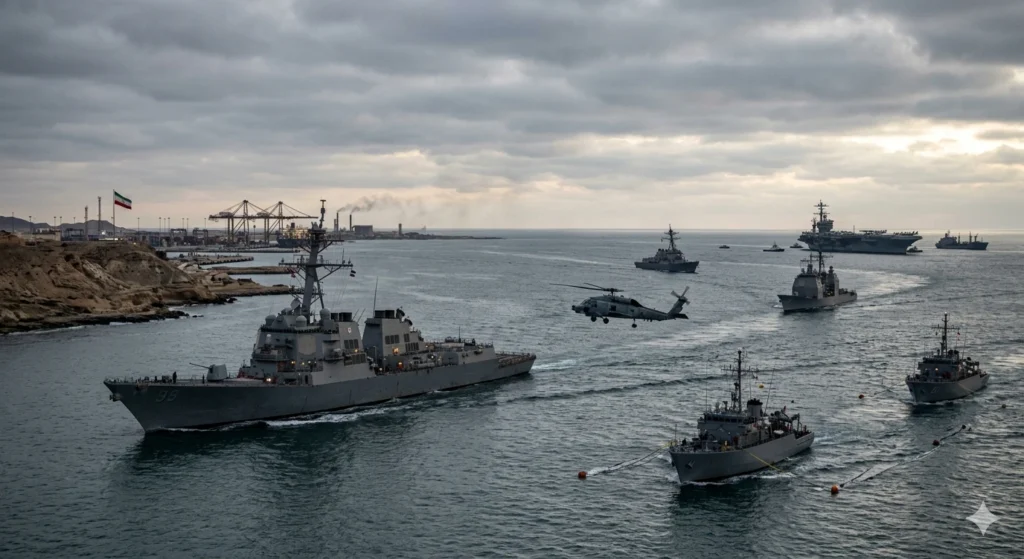
At the same time, USS Gerald R. Ford and the USS Abraham Lincoln are already in the Persian Gulf, each commanding a strike group with three guided-missile destroyers. Consequently, the US already has significant firepower positioned for the operation.
The Mine Threat
Alongside the blockade, clearing Iranian mines presents an equally serious challenge. A CNN report says Iran has started planting mines in the Strait of Hormuz, but other sources claim only “a few dozen” were put in. Iran still keeps more than 80% of its mines and could potentially add hundreds more.
In response, US Central Command confirmed that two destroyers, the USS Michael Murphy and USS Frank E. Peterson, transited the strait on Saturday, specifically to begin “setting conditions for clearing mines” and establishing a safe passage corridor.
But those destroyers were just the start. The actual minesweeping work relies primarily on underwater drones, littoral combat ships equipped with mine-countermeasures packages, and specialized helicopters. Mines can be built in many ways. Some slip past normal warship patrols, so clearing them is tricky.
Strikingly, one report revealed that Iran itself lost track of some mines it planted in the strait, leaving it unable to fully reopen the waterway even after ceasefire discussions.
Allied Support and Legal Considerations
The Navy will probably need help from allies, too. Analyst Alessio Patalano said the US would likely lean more on allies and partners than people expect to clear mines thoroughly. Nevertheless, a senior NATO official confirmed that the UK is leading a coalition of more than 40 nations to reopen the strait and protect freedom of navigation.
Under international law, the United States may legally impose a blockade because it is a party to the conflict. However, it must declare and notify the blockade, enforce it effectively, apply it impartially to all nations, and avoid blocking neutral ports or the strait itself for non-Iranian shipping.
Global Economic Stakes
The urgency stems from staggering economic consequences. Iran has cut about one-fifth of the oil and gas that usually moves through the strait, so Brent crude jumped roughly 10–13%, and analysts warn it could hit $110 a barrel or more if the disruptions continue.
So the US Navy isn’t only carrying out military work anymore, it’s also taking on the pressure of the world economy.
“Sources: CNN/KVIA, CNBC, CBS News, Axios, The Washington Times, The Conversation”
Recent News:
UFC 327: Trump Makes First Appearance Since War