
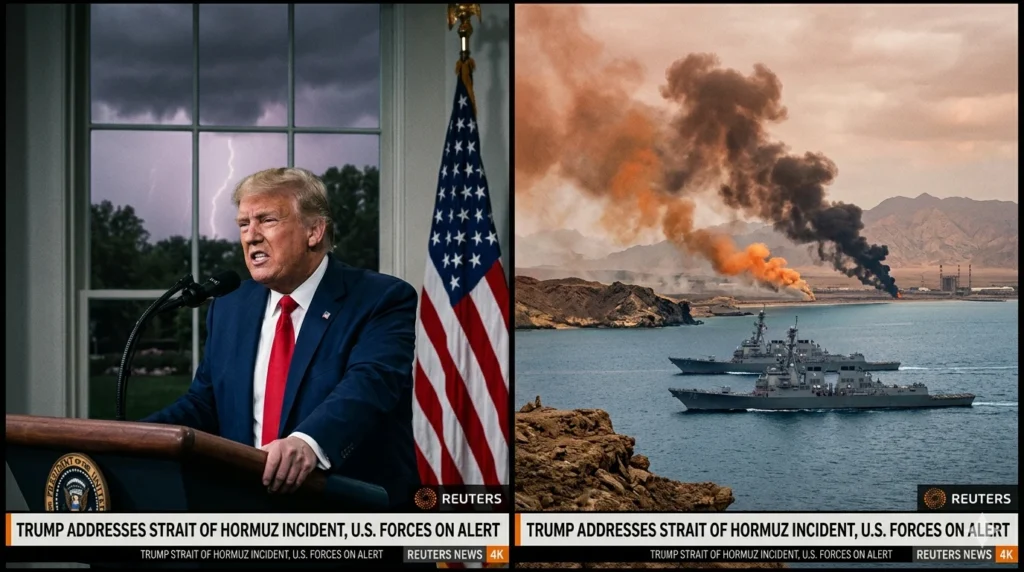

Trump Threatens Iran: President Donald Trump issued a chilling ultimatum to Iran on Tuesday morning. He wrote on his social media platform, “A whole civilization will die tonight, never to be brought back again. I don’t want that to happen, but it probably will.” The stark warning sent shockwaves across the world. Consequently, global leaders rushed to respond before the clock ran out.
The Deadline and the Demand
Trump set an 8 p.m. ET deadline for Iran to fully reopen the Strait of Hormuz. Furthermore, he demanded that Tehran agree to a broader deal before that hour. He threatened to destroy all of Iran’s bridges and power plants if the regime refused. Meanwhile, he offered a narrow window of hope. He also wrote, “However, now that we have Complete and Total Regime Change, where different, smarter, and less radicalized minds prevail, maybe something revolutionarily wonderful can happen.”
Additionally, Trump told reporters he believed Iran was negotiating. He called Iran’s response to his administration’s 15-point peace proposal “a significant step,” yet insisted the offer was “not good enough.” Nevertheless, diplomatic channels remained open as the hours ticked down.
Strikes Hit Iran Before the Deadline
Even before the deadline passed, the war escalated sharply. Airstrikes hit two bridges and a train station across Iran on Tuesday. Moreover, the US. military struck dozens of military targets on Kharg Island overnight, according to a US. official. Kharg Island serves as Iran’s key oil export hub. Therefore, the strike carried enormous strategic weight.
At least 18 civilians were killed by the strikes in one province alone on Tuesday, according to an Iranian official. Specifically, Iran’s Alborz Province suffered heavy losses, including two young children, according to the semi-official Mehr News Agency. Additionally, the Security Deputy of the Governor of Isfahan confirmed an attack on a railway bridge in Kashan. He said two people were killed and three others were injured.
Iran Defies Trump and Calls for Human Shields
Iran’s government did not back down. Instead, Iran’s Revolutionary Guard warned it would “deprive the US. and its allies of the region’s oil and gas for years” if Trump followed through with his threats. Furthermore, the IRGC declared it would no longer show “restraint” in choosing targets for retaliation, saying all previous considerations “have since been removed.”
On the ground, Iranian officials moved swiftly. Iranian official Alireza Rahimi issued a video message calling on “all young people, athletes, artists, students, university students and their professors” to form human chains around power plants. Thus, ordinary Iranians found themselves on the front lines of a geopolitical standoff.
A young teacher in Tehran told the Associated Press she feared the war would spread chaos, saying: “If we don’t have the internet, and if we don’t have electricity, water, and gas, we’re really going back to the Stone Age.” She spoke anonymously for her safety. As a result, the human cost of the conflict came into sharp focus.
International Alarm Over War Crime Concerns
World leaders reacted with alarm. French Foreign Minister Jean-Noël Barrot joined a growing chorus of voices calling for restraint, saying attacks targeting civilian and energy infrastructure “are barred by the rules of war, international law.” Similarly, U.N. Secretary-General António Guterres warned the US. that attacks on civilian infrastructure violate international law.
Human rights experts went further. Human rights expert Kenneth Roth stated that Trump was “openly threatening” to carry out a war crime by vowing to target “a whole civilization.” Despite these warnings, Trump remained defiant. He told reporters he was “not at all” concerned about committing war crimes.
A Global Energy Crisis Deepens
Beyond the battlefield, the economic fallout grew severe. Fatih Birol, head of the International Energy Agency, warned that the current oil and gas crisis was “more serious than the ones in 1973, 1979 and 2002 together,” adding that the world has “never experienced a disruption to energy supply of such magnitude.”
Consequently, allied nations scrambled for alternatives. Japan and the Philippines sought to strike direct agreements with Iran, while South Korea sought assistance from other regional players, rather than relying on Trump’s efforts to reopen the Strait.
Qatar Sounds the Alarm
Regional voices also urged caution. Qatar’s Foreign Ministry spokesperson, Majed Al-Ansari, warned: “There are no winners in the continuation of this war,” adding that the world stood “very close” to a point at which escalation could no longer be controlled.
What Happens Next
As the 8 p.m. deadline drew near, the world watched anxiously. Officials involved in diplomatic efforts confirmed that talks were ongoing, but Iran had rejected the latest American proposal, and it was unclear if a deal would come in time. Therefore, the next few hours carry consequences not just for Iran and the United States, but also for global stability, energy markets, and international law.
“Sources: PBS NewsHour, NBC News, CBS News, CNN, ABC News, Al Jazeera, Associated Press”
Recent News:
Artemis II: How Astronauts Will See the Moon Like Never Before