
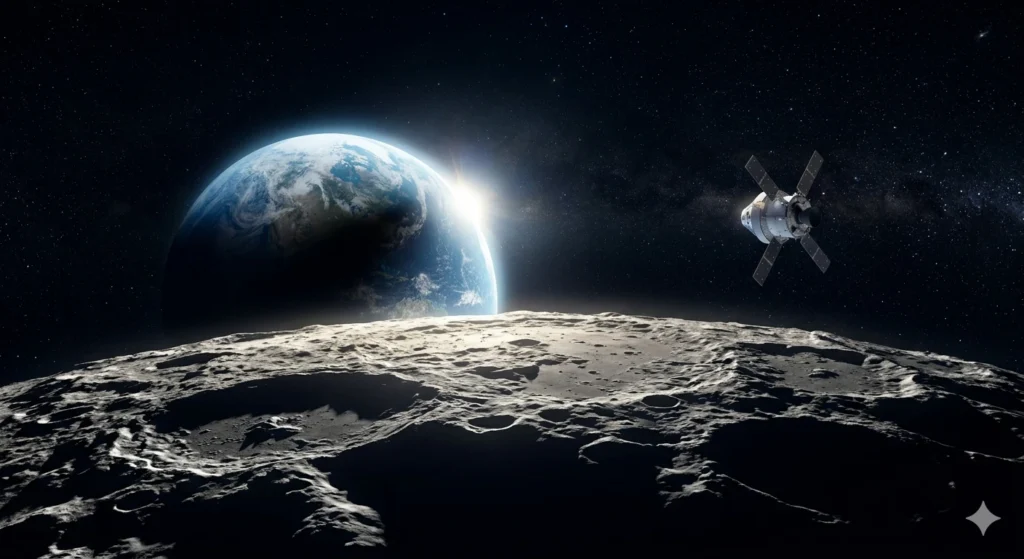

NASA has officially released a remarkable set of images from the Artemis II mission. The Artemis II crew captured these breathtaking photos during their historic lunar flyby on April 6, 2026. Consequently, the world now holds its breath in awe. This milestone marks humanity’s first crewed return to the Moon since Apollo 17 in 1972. Therefore, the release of these images carries enormous scientific and emotional weight for millions worldwide.
A New Icon: The ‘Earthset’ Photo
The first newly released photo shows “Earthset,” a moment captured from the far side as Earth dipped out of view beyond the Moon’s opposite edge. Furthermore, the White House shared this image on Tuesday morning via X, giving the world its first glimpse. Notably, this new image serves as a kind of recreation of the iconic “Earthrise” photo taken during Apollo 8 in 1968. However, there is a key difference. The Apollo 8 photo showed Earth reemerging into view, rather than disappearing, as astronauts Bill Anders, Frank Borman, and Jim Lovell flew around the Moon. As a result, this new “Earthset” image stands as its own distinct chapter in the history of space photography. Indeed, it captures a perspective no human camera has ever captured from that distance.
The Crew and Their Extraordinary Mission
Working across two shifts over roughly five hours, NASA astronauts Reid Wiseman, Victor Glover, Christina Koch, and Canadian Space Agency astronaut Jeremy Hansen captured approximately 10,000 photos. Additionally, the flyby itself lasted seven hours, during which the crew enjoyed views of the lunar surface previously unseen by human eyes. Specifically, about 21% of the Moon’s mysterious far side received illumination from the Sun during its approach. Thus, the crew documented terrain that no human had ever directly observed before. Moreover, the astronauts photographed and described impact craters, ancient lava flows, and surface cracks formed as the Moon slowly evolved over billions of years. Meanwhile, astronaut Victor Glover was particularly captivated by the jagged topography along the Moon’s terminator, the dividing line between its illuminated and dark sides. He radioed to Mission Control: “Boy, I am loving the terminator.”
Breaking the Distance Record
Beyond the photography, the Artemis II crew also shattered a long-standing human spaceflight record. The astronauts reached 252,756 miles from Earth more than 4,100 miles beyond the previous record set by the Apollo 13 astronauts in 1970 during their emergency return home. Therefore, Wiseman, Glover, Koch, and Hansen officially became the most widely traveled humans in history. Interestingly, this distance record fell at 1:56 p.m. EDT, as Orion surpassed Apollo 13’s mark of 248,655 miles. Subsequently, the crew pressed onward toward the closest lunar approach. Closest approach occurred at 7:02 p.m. EDT, with Orion flying just 4,067 miles above the lunar surface.
A Rare Solar Eclipse from Beyond the Moon
Perhaps the most extraordinary moment of the flyby involved a solar eclipse. The Artemis II crew witnessed a very special solar eclipse as the Moon moved directly between them and the Sun. Remarkably, the period when the Sun was entirely blocked from view lasted nearly an hour for the astronauts. By contrast, totality on Earth typically lasts only a few minutes. Therefore, the crew experienced something genuinely unprecedented in human history. Furthermore, the crew studied the solar corona, the Sun’s outermost atmosphere, as it appeared around the Moon’s edge during the eclipse. Additionally, the astronauts spotted planets including Mars, Venus, and Saturn, as well as stars and Earthshine, the soft glow of Earth’s reflected light.
Meteoroid Flashes and Scientific Discoveries
In addition to the eclipse, the crew made another surprising discovery. During the darkened phase of the eclipse, the astronauts reported six light flashes from meteoroids striking the lunar surface at many thousands of miles per hour. Consequently, scientists on the ground immediately began analyzing this data. Researchers plan to review images, audio, and other data to pinpoint more accurately the times and locations of the flashes, and they will also seek input from amateur astronomers who observed the Moon simultaneously. Therefore, even citizen scientists now play a role in verifying these discoveries. Meanwhile, science team lead Kelsey Young told the crew: “I can’t say enough how much science we’ve already learned and how much inspiration you provided to our entire team, the lunar science community, and the entire world.”
The Human Experience Behind the Lens
Beyond the data and records, the crew also reflected deeply on what they witnessed. Canadian Space Agency astronaut Jeremy Hansen described the emotional impact during a conversation with NASA Administrator Jared Isaacman. He stated, “When we were on the far side of the moon, looking back at Earth, you really felt like you weren’t in a capsule. You’d been transported to the far side of the moon. It really just bent your mind.” Similarly, Commander Reid Wiseman praised the NASA science team after the flyby concluded. He said, “We were well prepared, and we appreciate all of you. This is what we do best when we all come together and work as a team. Y’all knocked it out of the park.”
What Comes Next
Although the flyby has ended, the scientific work continues. NASA plans to publicly release the full set of Moon photos, but due to deep-space downlink limitations, most images will not be transferred and processed until after the crew returns to Earth. Specifically, the Artemis II astronauts are now on their journey home, with splashdown scheduled for Friday, April 10, in the Pacific Ocean near San Diego. Furthermore, the crew will discuss their lunar observations with the science team on Tuesday, April 7, in a live broadcast on NASA’s coverage channels.
Ultimately, the Artemis II mission has delivered far more than photographs. It has reignited humanity’s connection to the cosmos and proven once again that exploration drives us forward.
Sources: NASA.gov | NBC News | ABC7 | Astronomy.com | WRAL.com | April 7, 2026