
March 26, 2026 | Space & Science Planetary Defense Report
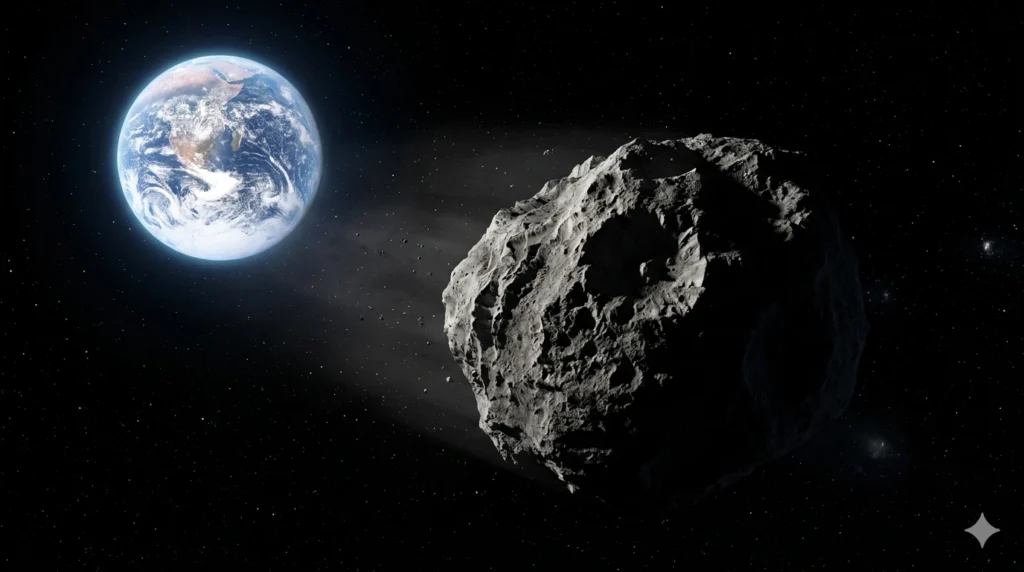
Space may be vast, but this week it feels a little crowded. NASA is currently tracking 5 asteroids approaching earth in rapid succession, ranging from car-sized rocks to plane-sized space boulders, sparking fresh public curiosity about just how safe our planet really is.
NASA’s Asteroid Watch Dashboard actively tracks asteroids and comets making relatively close approaches to Earth, displaying the next five encounters within 4.6 million miles, about 19.5 times the distance to the Moon.
The Asteroids approaching earth currently on NASA’s radar include: 2026 FM3, a car-sized 15-foot rock that passed within just 148,000 miles of Earth at 12,168 mph; 2026 FX3, a plane-sized 68-foot asteroid; 2026 FT2, a house-sized 49-foot space rock; and two more, the bus-sized 2026 FQ2 and plane-sized 2026 FG3, passing at roughly 1.5 million and 1.93 million miles respectively.
So should you panic? Experts say no. NASA’s Center for Near-Earth Object Studies confirms that all current close approaches are safe and that the vast majority of near-Earth objects have orbits that pose no impact risk.
However, scientists remain watchful. NASA‘s planetary defense officer Kelly Fast warned that what keeps her up at night are medium-sized “city killer” asteroids roughly 140 meters and larger that are small enough to go undetected but large enough to cause significant regional damage, and whose locations remain largely unknown.
As of March 2026, astronomers have detected 2,532 potentially hazardous asteroids, of which 153 are larger than 1 kilometer in diameter, though none pose any sufficient risk of impact within the next 100 years.
Small asteroids measuring up to 30 feet across impact Earth roughly once every ten years, but they usually pose no hazard to life on the surface. For now, the skies remain safe, but NASA’s vigil never sleeps.
“Sources: NASA JPL Asteroid Watch, NASA CNEOS, Newsweek, StarWalk Space, Wikipedia, Near Earth Object Database”